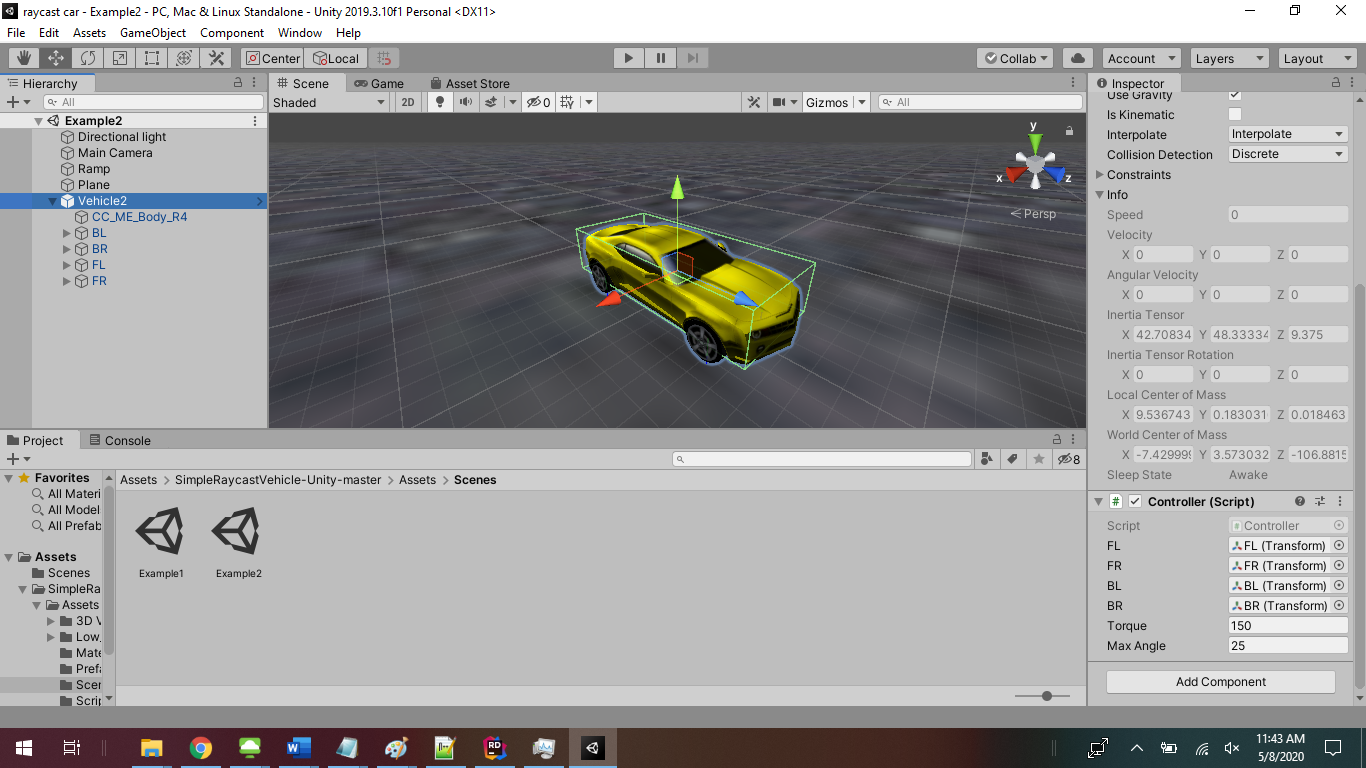
//script added to car:
using UnityEngine;
using System.Collections;

[RequireComponent(typeof(Rigidbody))]
public class Controller : MonoBehaviour {

	private Rigidbody rb;
	public Transform FL, FR, BL, BR;
	public float torque = 100;
	public float maxAngle = 30;

	// Use this for initialization
	void Start () {
		rb = GetComponent<Rigidbody> ();
		rb.centerOfMass = new Vector3 (0, -.5f, 0);
	}

	// Update is called once per frame
	void FixedUpdate () {

		float forward = Input.GetAxis ("Vertical");
		float steer = Input.GetAxis ("Horizontal");

		Vector3 ff = (Vector3.forward * torque * forward);
		//Vector3 ss = (Vector3.up * torque * 100 * steer);

		rb.AddRelativeForce (ff);
		//rb.AddRelativeTorque (ss);
		if (FL & FR)
		{
			FR.localRotation = Quaternion.AngleAxis (steer * maxAngle, Vector3.up);
			FL.localRotation = Quaternion.AngleAxis (steer * maxAngle, Vector3.up);

		}
	}
}

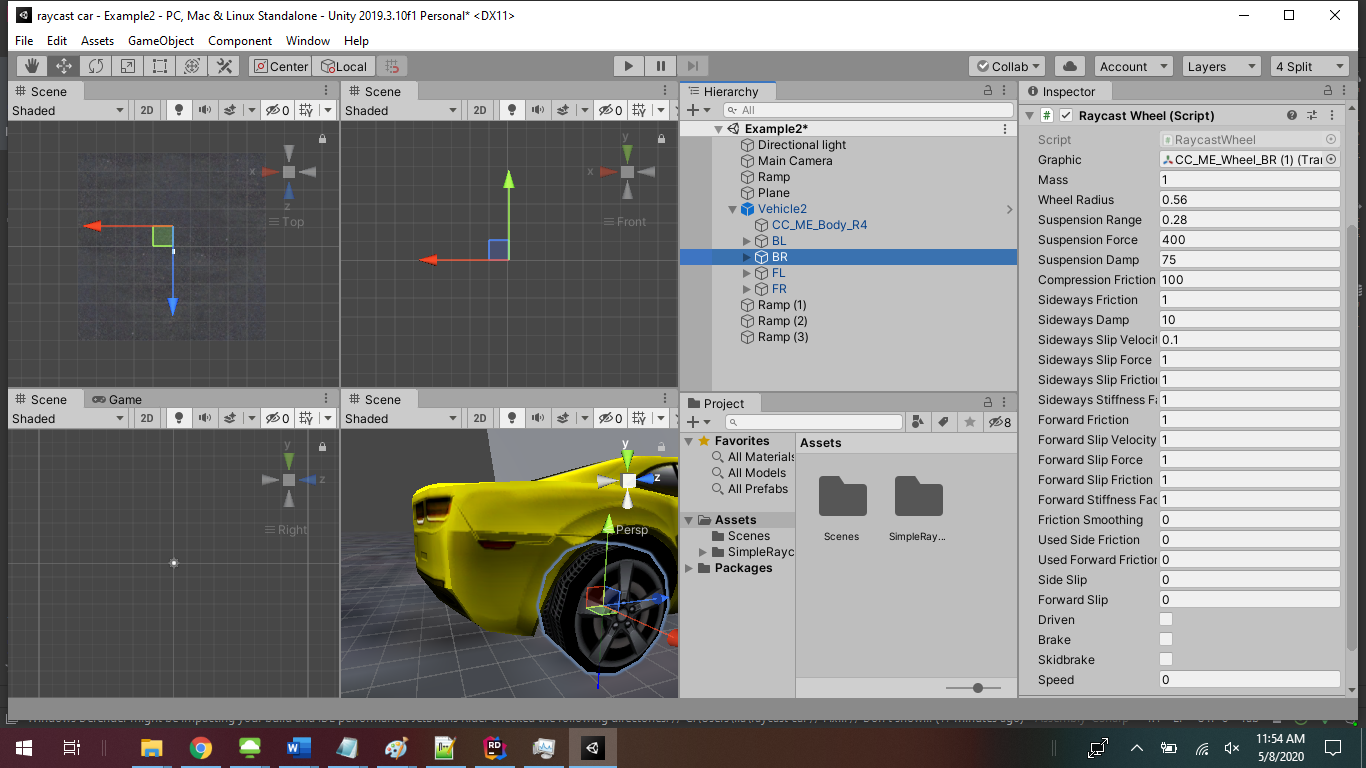
//script added for each wheel - raycast

using UnityEngine;
using System.Collections;

// Do test the code! You usually need to change a few small bits.

[RequireComponent(typeof(Rigidbody))]
public class RaycastWheel : MonoBehaviour {

   // More advanced Vehicle Raycast wheel

   public Transform graphic;

   public float mass = 1.00f;
   public float wheelRadius  = 0.5f;
   public float suspensionRange  = 0.10f;
   public float suspensionForce  = 0.00f;
   public float suspensionDamp  = 0.00f;
   public float compressionFrictionFactor  = 0.00f;

   public float sidewaysFriction  = 0.00f;
   public float sidewaysDamp  = 0.00f;
   public float sidewaysSlipVelocity  = 0.00f;
   public float sidewaysSlipForce  = 0.00f;
   public float sidewaysSlipFriction  = 0.00f;
   public float sidewaysStiffnessFactor  = 0.00f;

   public float forwardFriction  = 0.00f;
   public float forwardSlipVelocity  = 0.00f;
   public float forwardSlipForce  = 0.00f;
   public float forwardSlipFriction  = 0.00f;
   public float forwardStiffnessFactor  = 0.00f;

   public float frictionSmoothing  = 1.00f;

   public float usedSideFriction  = 0.00f;
   public float usedForwardFriction  = 0.00f;
   public float sideSlip  = 0.00f;
   public float forwardSlip  = 0.00f;

   public bool driven  = false;
   public bool brake  = false;
   public bool skidbrake  = false;

   public float speed  = 0.00f;

   private RaycastHit hit;

   private Rigidbody parent;

   private float wheelCircumference = 0.00f;

   private bool grounded = false;

   public bool IsGrounded
   {
      get
      {
         return grounded;
      }
   }

   void Start ()
   {
      wheelCircumference = wheelRadius * Mathf.PI * 2;
      parent = transform.root.GetComponent<Rigidbody>();
   }

   void  FixedUpdate ()
   {
      // the object this script is attached to does not move. This ray is like imagining
      // that the shock is compressed as much as possible, and then extends out as far as it can before it hits the ground.
      // If it doesn't, then the wheel is fully extended.

      Vector3 down = transform.TransformDirection(Vector3.down);

      // if raycast from position downwards with range suspensionrange + wheelRadius
      // and hit.collider != the parent (car)

      // calculate the force of the shock as it pushes on the car and the earth due to compression.
      // Since the earth does not move, this is an upward force on the car only

      if(Physics.Raycast (transform.position, down, out hit, suspensionRange + wheelRadius) && hit.collider.transform.root != transform.root)
      {
         // how fast is the wheel moving relative to the ground, without taking the wheel's rotation into account
         Vector3 velocityAtTouch = parent.GetPointVelocity(hit.point);

         // calculate spring compression
         // difference in positions divided by total suspension range
         float compression = hit.distance / (suspensionRange + wheelRadius);
         compression = -compression + 1;

         // final force
         Vector3 force = -down * compression * suspensionForce;


         // velocity at point of contact transformed into local space
         Vector3 t = transform.InverseTransformDirection(velocityAtTouch);

         // local x and z directions = 0
         // Here we set t equal to the speed at which the shock is contracting / expanding
         t.z = 0;
         t.x = 0;

         // back to world space * -damping
         // this force simulates the force exerted by the friction in the suspension.
         Vector3 shockDrag = transform.TransformDirection(t) * -suspensionDamp;

         // forwardDifference = local speed along the z axis
         // the difference between the speed of the ground and the wheel taking rotation + the car's velocity into account.
         // (in local space, that means, relative to the wheel. So if you were standing on the wheel surface,
         // how fast would you percieve the ground moving? Either squashing you every time the wheel goes around
         // (not skidding, absolute value close to zero) or scrapping you to bits (skidding, large absolute value))

         float forwardDifference = transform.InverseTransformDirection(velocityAtTouch).z - speed;

         // newForwardFriction = interpolated between forwardFriction (constant) and
         // forwardSlipFriction. Interpolation is forwardSlip squared.
         // so if forwardSlip = 1, newForwardFriction = forwardSlipFriction


         //Ok, this next part is not related to real physics an any way whatsoever. Ummm... Basically the friction that the wheel has with
         // the ground changes (using a lerp function over time) depending on the current friction force.
         // I guess this simulates how once a car starts skidding, the friction goes down so it skids more.
         // __________________z-friction__________________
         // move the current working friction value toward the minimum about porportional to the "skidding-ness" squared

         float newForwardFriction = Mathf.Lerp(forwardFriction, forwardSlipFriction, forwardSlip * forwardSlip);

         // increase the current working friction value depending on how hard the shock is pressing the wheel against the ground
         newForwardFriction = Mathf.Lerp(newForwardFriction, newForwardFriction * compression * 1, compressionFrictionFactor);

         if(frictionSmoothing > 0)
            usedForwardFriction = Mathf.Lerp(usedForwardFriction, newForwardFriction, Time.fixedDeltaTime / frictionSmoothing);
         else
            usedForwardFriction = newForwardFriction;

         // calculate one component of the friction force: the difference between the wheel surface velocity and ground surface
         // velocity times friction (not based on real physics AFAIK)
         Vector3 forwardForce = transform.TransformDirection(new Vector3(0, 0, -forwardDifference)) * usedForwardFriction;

         // calculate how much we be slippin  (if the force is high, the tire will give and slip on the road)
         forwardSlip = Mathf.Lerp(forwardForce.magnitude / forwardSlipForce, forwardDifference / forwardSlipVelocity, forwardStiffnessFactor);

         float sidewaysDifference = transform.InverseTransformDirection(velocityAtTouch).x;
         float newSideFriction = Mathf.Lerp(sidewaysFriction, sidewaysSlipFriction, sideSlip * sideSlip);
         newSideFriction = Mathf.Lerp(newSideFriction, newSideFriction * compression * 1, compressionFrictionFactor);

         if(frictionSmoothing > 0)
            usedSideFriction = Mathf.Lerp(usedSideFriction, newSideFriction, Time.fixedDeltaTime / frictionSmoothing);
         else
            usedSideFriction = newSideFriction;

         // ____________________________________
         // this is much the same as the block above, but for the x-axis
         // __________________x-friction__________________

         Vector3 sideForce = transform.TransformDirection(new Vector3(-sidewaysDifference, 0, 0)) * usedSideFriction;
         sideSlip = Mathf.Lerp(sideForce.magnitude / sidewaysSlipForce, sidewaysDifference / sidewaysSlipVelocity, sidewaysStiffnessFactor);

         // this thing is totally made up. It's as if god's hand nudges the car back on course whenever it is moving sideways,
         // by a factor of sidewaysDamp
         t = transform.InverseTransformDirection(velocityAtTouch);
         t.z = 0;
         t.y = 0;

         Vector3 sideDrag = transform.TransformDirection(t) * -sidewaysDamp;

         // By the some of all you combined, I become CAPTAIN FORCE
         parent.AddForceAtPosition(force + shockDrag - forwardForce + sideForce + sideDrag, transform.position);


         // for every action there is an opposite reaction: the wheel adds a force on the ground, but the ground does not move,
         // so that force is added to the car instead in the opposite direction (this lets the engine propel the thing forward).
         // But!!! we also have to add a force on the engine, because otherwise we'd be adding force from nothing.
         // The opposite reaction is this force on the motor. The motor is not a rigidbody, it is a made up thing in the Car.js script
         if(driven)
         {
            //car.AddForceOnMotor (forwardDifference * usedForwardFriction * Time.fixedDeltaTime);
         }
         else
         speed += forwardDifference;

         graphic.position = transform.position + (down * (hit.distance - wheelRadius));
      }
      else
      {
         graphic.position = transform.position + (down * suspensionRange);
      }

      speed = parent.velocity.magnitude;

      graphic.transform.Rotate(360 * (speed / wheelCircumference) * Time.fixedDeltaTime, 0, 0);
   }

   void  OnDrawGizmosSelected ()
   {
      Gizmos.color = new Color(0,1,0,1);
      Vector3 direction = transform.TransformDirection (-Vector3.up) * (this.wheelRadius);
      Gizmos.DrawRay(transform.position,direction);

      Gizmos.color = new Color(0,0,1,1);
      direction = transform.TransformDirection (-Vector3.up) * (this.suspensionRange);
      Gizmos.DrawRay(new Vector3(transform.position.x,transform.position.y - wheelRadius,transform.position.z),direction);
   }
}
